The City Line Running Through Fletcher Hills Decides More Than Your Mailing Address
August 13, 2026
August 13, 2026
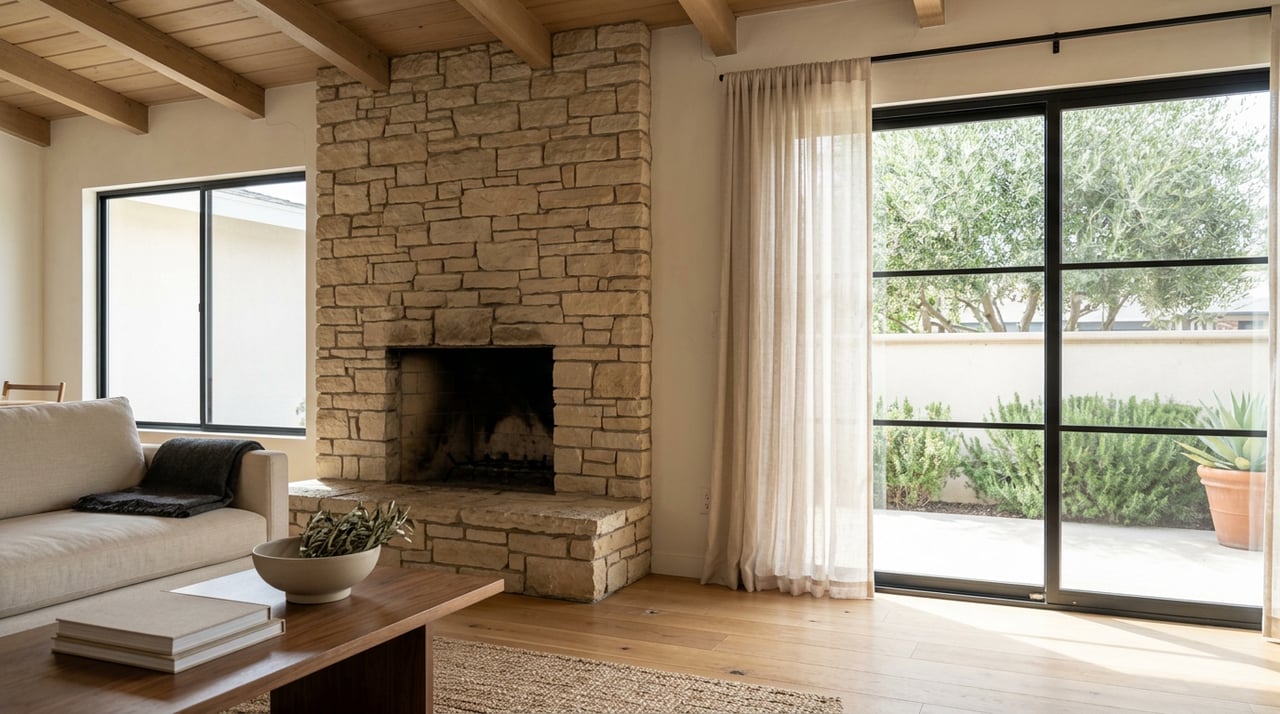
Two homes a block apart in Fletcher Hills can carry the same "Fletcher Hills" name on the listing, the same midcentury ranch bones, the same view of the valley at sunset, and still answer to different cities, different school assignments, and different property tax structures. That is not a hypothetical quirk. It is how the neighborhood is actually built, and it is the kind of detail that shows up after escrow opens rather than before, when a buyer assumes an address tells them everything they need to know.
Fletcher Hills traces its start to 1927 and 1928, when developer and California state senator Ed Fletcher began the tract, with most of the midcentury ranch homes going up through the 1930s and 1940s. The original model home, a Spanish Colonial built in 1929, still stands on Wakefield Court as a marker of where it all began. What Fletcher never drew was a single, tidy boundary. The neighborhood he built sits astride the line separating the city of El Cajon from the city of La Mesa, and that line does not politely follow the edges of the neighborhood. It cuts through it.
Most buyers assume a home's mailing address tells them which school their kids will attend. In Fletcher Hills, that assumption breaks down at the parcel level. Fletcher Hills Elementary carries a physical address of 2330 Center Place in El Cajon, 92020, but according to federal school data and the state's own Ed-Data reporting, it is officially part of the La Mesa-Spring Valley School District, not the Cajon Valley Union School District that covers most of El Cajon's elementary-age children. The district itself confirms this reach: La Mesa-Spring Valley serves the city of La Mesa, the unincorporated pockets of Casa de Oro, Mount Helix, and Spring Valley, and a portion of El Cajon that includes this specific slice of Fletcher Hills.
Meanwhile, general descriptions of the broader Fletcher Hills area, including citywide market guides, describe the neighborhood as falling under Cajon Valley Union for elementary and middle grades. Both statements are true. They are just true for different parcels. The elementary assignment depends on which side of a boundary that has nothing to do with the neighborhood's name a given home sits on. High school is more consistent. Grossmont Union High School District serves the area regardless of which elementary boundary a home falls into, so that part of the puzzle does not shift.
This is not a hypothetical inconvenience. A buyer touring homes across several streets in Fletcher Hills, assuming they are all zoned the same way because they are all marketed under the same neighborhood name, could be planning around the wrong elementary school entirely.
Here is what can be confirmed for each side of the divide, and just as tellingly, what cannot be confirmed with equal precision, because the two cities do not publish comparable data in the same format.
| El Cajon side (92020) | La Mesa side | |
|---|---|---|
| City jurisdiction | City of El Cajon | City of La Mesa |
| Elementary assignment | Cajon Valley Union for most parcels | La Mesa-Spring Valley, including the parcels feeding Fletcher Hills Elementary itself |
| High school district | Grossmont Union High School District | Grossmont Union High School District |
| Published effective property tax rate | Median effective rate of 1.30% in the 92020 ZIP, per current assessor-based analysis | No separately published neighborhood-level rate; assessed through La Mesa's own bond and Community Facilities District structure |
That gap in the bottom row is itself informative. Within El Cajon alone, effective property tax rates are not uniform. The 92020 ZIP, which covers the El Cajon side of Fletcher Hills, carries a median effective rate of 1.30 percent, while the neighboring 92019 ZIP sits at 1.22 percent, a spread tied directly to how school district boundaries and local assessment districts are drawn. If two ZIP codes inside a single city can produce a real, measurable tax difference, crossing into a second city's entirely separate set of voter-approved bonds only adds another layer a buyer cannot read off a listing sheet. California's base property tax rate is fixed at 1 percent of assessed value under Proposition 13, but the additional levies for school bonds, water districts, and other local measures stack on top of that base, and those levies are drawn by district, not by neighborhood name.
None of this administrative complexity has slowed demand. Over the three months ending May 2026, El Cajon's citywide median sale price was $712,000. Zillow's separate estimate of average home value across the city's entire housing stock, a different measure that includes homes not currently for sale, stood at $818,591 as of June 2026. Neighborhood-level tracking for Fletcher Hills across snapshots taken between mid-2025 and late 2025 placed the area's median consistently in the $880,000 to $939,000 range. That is not a single outlier reading. It is a pattern that holds across multiple independent snapshots, which matters more than any one number, because it shows a durable premium rather than a temporary spike.
Measured against the citywide median sale price, that premium runs roughly $170,000 to $225,000. Measured against Zillow's broader average value figure instead, the gap narrows to something closer to $60,000 to $120,000. The size of the premium depends on which citywide number you treat as the baseline, but a premium exists either way, and it is not explained by square footage alone. Fletcher Hills homes are not larger than the rest of El Cajon's housing stock by that much. What the premium reflects is the hillside setting itself, the closer proximity to La Mesa Village and Grossmont Center, and a market that treats the neighborhood as its own micro-area regardless of which city collects the property tax check. Buyers pricing a Fletcher Hills home off the city's broader median, whichever version of that median they pick, will consistently undershoot what the market actually pays.
One local broker summed up the neighborhood’s appeal this way: "the sunsets here are the most beautiful I've ever seen" (as quoted in Homes.com's Fletcher Hills neighborhood guide). That kind of detail does not show up in a spreadsheet, but it is part of why buyers keep paying above the surrounding city's numbers for a home here.
The city line is not confined to school rosters and tax bills. It runs through the places residents actually use every week. Harry Griffen Park, at 53 acres the largest park in La Mesa, sits right at the edge of Fletcher Hills where the two cities meet. It has a gated dog park, miles of dirt and paved trails, and an amphitheater that seats up to 360 people, and it is reachable through a pedestrian-only entrance from Blackthorne Court inside Fletcher Hills itself, even though the park is technically La Mesa's, not El Cajon's. A few minutes away, La Mesita Park offers a skatepark and lighted baseball fields on the other side of the same invisible line.
Daily errands follow the same pattern. Residents on the El Cajon side handle groceries at the Smart and Final Extra and Albertsons inside the Fletcher Hills Town and Country Shopping Center, then cross toward La Mesa Village or Grossmont Center for anything more substantial. Long-running local spots like Beef 'n Bun, a burger counter that has operated in the neighborhood since the 1960s, and Finca Casa Blanca, known locally for its Super Nachos, sit inside a neighborhood that functions as one place socially while remaining two places administratively. The 130-foot mushroom-shaped Fletcher Hills Water Tower, visible from much of the surrounding hillside, is the closest thing the area has to a shared landmark that does not care which city collects its address.
If you are comparing homes on both sides of Fletcher Hills, a few checks are worth doing before you get attached to a specific street:
None of this makes Fletcher Hills a harder place to buy into. It makes it a neighborhood where the paperwork deserves the same attention as the view.
Is Fletcher Hills in El Cajon or La Mesa? Both. The neighborhood was developed as one tract but the city limits divide it, with the larger share generally associated with El Cajon's 92020 ZIP and a portion falling inside La Mesa.
Which school district will my children attend if I buy in Fletcher Hills? It depends on the exact parcel. Fletcher Hills Elementary itself, despite its El Cajon address, is part of the La Mesa-Spring Valley School District, while other parts of the neighborhood are assigned to Cajon Valley Union. High school is more consistent, with Grossmont Union High School District serving the broader area.
Does the city line affect my property tax bill? It can. Effective property tax rates already differ between neighboring ZIP codes inside El Cajon alone, driven by which school bonds and assessment districts apply to a given parcel. Crossing into La Mesa introduces an entirely separate set of local bonds and CFDs that are not published at the same neighborhood level, which is exactly why pulling the parcel-specific tax rate area matters more than trusting the city name on the listing.
If you are weighing a home in Fletcher Hills against something in El Cajon proper or over toward La Mesa Village, the details that actually affect your monthly payment and your kids' school assignment live at the parcel level, not the neighborhood name. Zac Thayer has spent his career in these East County streets and can pull the specific school boundary and tax rate area for any address you are considering before you write an offer. Let's Connect.
This article is general information, not legal, tax or financial advice. Consult a qualified professional about your situation.
Experience personalized service, local expertise, and dedicated advocacy from consultation to closing. Zac Thayer is committed to helping you make confident real estate decisions every step of the way.
ZAC THAYER
Zac Thayer | CA DRE# 01992053
Eddington, Inc. | CA DRE# 02020845
278 Town Center Pkwy Ste 204 Santee, CA 92071